Look, Mother, I’m coming home at three o’clock tomorrow. Will you have everything down in the cellar by that time? The typewriter, and the snakes, and the xylophone, and the printing press. . .
—Alice Sycamore, You Can’t Take It With You[i]
Preparing one’s home for company is never an easy task; typically, it might require stashing away some dirty laundry or a pile of old magazines. In the case of the Sycamore family, however, it means hiding all the bric-a-brac of an eccentric, multi-generational, and free-spirited family—such as xylophones and snakes.
You Can’t Take It With You, written in 1936 by staples of the American theater George S. Kaufman and Moss Hart, tells the story of the unusual Sycamores, including a grandfather, a mother and father, two daughters, one with a husband, as well as a slew of family friends who came for one purpose, but evidently never left the Sycamore house to pursue another. This clan is asterisked by daughter Alice, seemingly the only member of the family plagued with the self-awareness to realize how this madcap family is perceived by the rest of the world. The play’s plot centers on Alice’s attempt to bring her more conventional and well-heeled fiance home to meet the family and present them as normal (think…every episode of Arrested Development). Naturally, hilarity ensues.
The play itself is a structural marvel, as at almost 80 years old, it feels fresh and familiar to the modern viewer, each of its three 40-minute acts feeling like an episode of a thoughtfully written television show. All the sitcoms we’ve been binge-watching on Netflix have been borrowing their humorous tropes from the comic stylings of Messrs. Kaufman and Hart. Act one serves as an informative exposition; act two is an eventful dinner party gone wrong that ends in an accidental gunpowder explosion (and includes a police raid for tax evasion and the innocent printing of polemical and anti-patriotic political propaganda). Act three delivers a heartfelt resolution eliciting the appropriate and audible “aw,” as the Sycamores, despite their eccentricity, offer a palliative solution to the travails of life itself. In the midst of all this, the play’s setting becomes an additional character and the aesthetic realization of the narrative text. This space doesn’t drive the plot, but rather propels it, creating an encouraging environment for whatever mayhem or serenity (but mostly mayhem) takes place. So, without further ado, welcome to the Sycamore home, where the family living room functions as the sole location for the story.
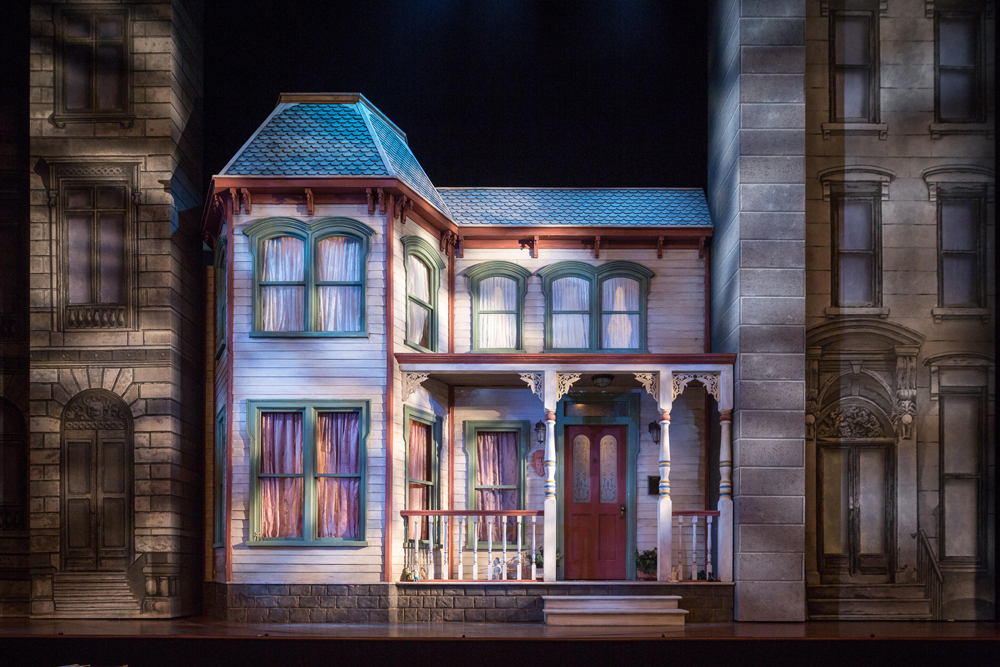 But before we enter the Sycamore home as guests, we must first be introduced to its exterior. According to scenic designer David Rockwell, “We wanted the audience to get the sense that this family doesn’t quite conform to their surroundings . . . so, rather than a standard show curtain, [the audience first sees] the front porch of a fully three-dimensional, faintly Victorian, turn-of-the-century house.”[ii] Comically sandwiched between two towering modern apartment buildings, this period house set in the context of the urban landscape possesses an architectural twinkle in its eye, “playfully hinting at the quirky family that the audience is about to meet.”[iii] This charming facade also alludes to the iconoclastic appreciation of history and ancestry possessed by its residents. After all, the house has been in the family for years: “The family’s patriarch, Grandpa Vanderhof, had acquired his house in 1913…and by contrasting its Victorian exterior with the new lithographic images of townhouses on either side would suggest [a] history, and reflect the family’s individuality amidst the changing world outside their door.”[iv] While the exterior of the house does not play an active role in the play itself, it does quite literally set the stage for what is to unfold.
In order to allow the audience to enter the family home, Rockwell employed a turntable, a trope of contemporary scenic design. Often used as a convenient vehicle for transporting large sets quickly and efficiently, the device is occasionally more thoughtfully utilized, either to offer the audience more complex perspectives of the onstage action, or to conjure a more cinematic motion for the performance space. Rockwell explains, “It is a simple way to reveal something while still being able to have a solid foundation—in this case, the interior of the house with its staircase and walls of set dressing.”[v]
Alongside this idea of concealing and revealing, the turntable also aids in pacing the audience’s departure from the episodic world of the play. At the end of the second act, for example, as fireworks explode over the frazzled house guests (the result of the rogue spark of gunpowder), a theatrical blackout would not be appropriate, as such a severe device generally indicates a narrative conclusion; in farce comedy, continuing momentum is key. Thus, “as each act concludes, the action continues and eventually fades away as the house revolves back to its gray facade.”[vi] And here again, we are left with a nervous anticipation of what lies behind that charming façade—in this case, the Sycamores and their living room.
In modern theatrical design, like other design fields, the reductive question is typically asked, “What objects are necessary to define this space?” But in developing a space that nurtures and suggests a legacy, perhaps the more appropriate question is, “What objects make a home?” From the initial description of the setting in the script, we get the idea that a simplistic and conventional approach to living and decorating will not suffice: “The room we see is what is customarily described as a living room, but in this house the term is something of an understatement. The every-man-for-himself room would be more like it.”[vii] Kaufman and Hart describe a “room” that accommodates every man (and, of course, woman) and every desired action. They continue, “for here meals are eaten, plays are written, snakes collected, ballet steps practiced, xylophones played, printing presses operated—if there were room enough there would probably be ice skating. In short, the brood…goes on about the business of living in the fullest sense of the word.”[viii] This attitude comes to its comic and visual height in act two when, arriving on the wrong day for a dinner party; Alice’s fiance enters the living room with his fancy Wall Street family (dressed in tuxedos and an evening gown) to find the room the bazaar for a ballet lesson, with a drunk actress passed out on the couch, another woman (the mother) rediscovering her love of painting with her portrait subject a man costumed in the garb of antiquity, and an Erector set somehow being jerry-rigged, all of which is accompanied by the cadence of a xylophone played by the Sycamore son-in-law.
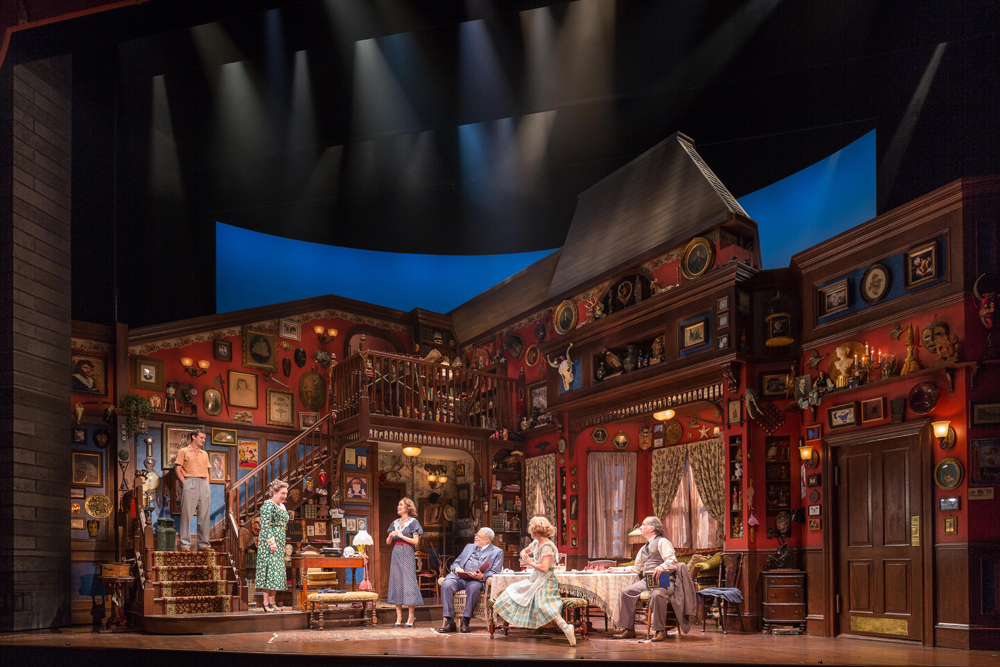
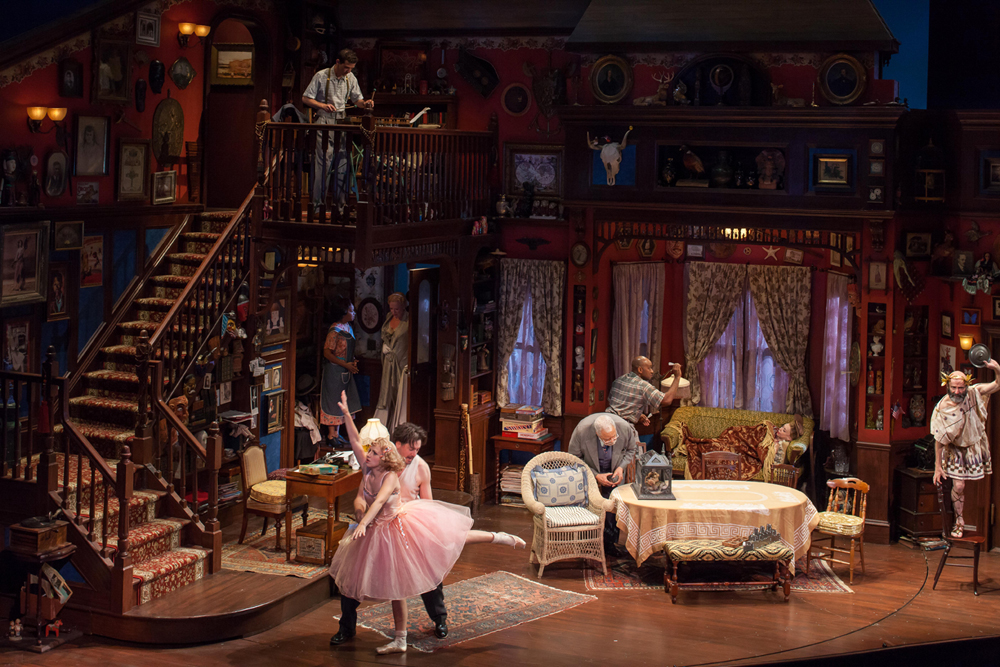
The chaotic composition of people and props in the space leaves no rest for the eye. Regardless of Alice’s frustration at her family’s inability to be “normal,” it is clear that this is a space of familial contentment and joy. As sociologists Mihaly Csikszentmihalyi and Eugene Rochberg-Halton report in their survey of domestic furnishings and attitudes, The Meaning of Things: Domestic Symbols and the Self, “[people] rarely complain about the house being in a mess or lacking in amenities or style, as long as the family is friendly, warm, active, and comfortable…because the interaction is harmonious.”[ix] In the case of the Sycamore family, it may be a cacophonous harmony, but it is a harmony all the same.
While the furniture is arranged as haphazardly as necessary, the surrounding walls tell the story. The famed and much feared contemporary New York Times theater critic Ben Brantley too simply enumerated his thoughts on the space as a “gloriously cluttered townhouse set.”[x] So much more adorns these walls! Buttressed by a sturdy wooden staircase that connects the first floor to the second, dusty red walls embrace the room. Communicating excitement amid maturity, these walls are fortified by “shelves…filled chock-a-block with books, art, and objects.”[xi] According to Rockwell, the room is inspired in part by Sir John Soane’s Museum in London, a historic house famous among architects for its aesthetic of collecting and display. Executed with an intentionally less connoisseurial eye, the walls of the Sycamore house replicate this idiosyncratic layering with family artifacts and heirlooms—or, as actress Annaleigh Ashford, who played Sycamore daughter Essie, called it, an “organized hoarding situation.”[xii] While most audience members are probably never close enough to admire the details of each piece, the objects’ presence en masse speaks to us from a place in history without forcing that history upon us. The costumes and text of the play anchor us in the period of the Great Depression, but the set presents a more timeless history.
While the spinning set and farcical action certainly provide enough to look at, the most compelling visual elements are these objects that collage the living room walls, as many possess stories of their own. Portraits of playwrights George S. Kaufman and Moss Hart, for example, gaze knowingly over the proceedings, as does a picture of the original 1936 Broadway company of the Sycamore family.[xiii]
But it’s not just the theatrical foremothers and forefathers who look out over the performance each night. The cast members of the Broadway production were invited to supply an object or two to decorate the set. According to Rockwell, “[Director Scott Ellis] felt that it would help the cast feel more connected to their setting by having some personal mementos present.”[xiv] Objects chosen by cast members included a jeweled trinket box, glass candlesticks, a duck-shaped pitcher actually used to pour water in performance, and scans of family photographs that adorn the desk of the playwright mother. Giving more depth to the idea of generations of family, a portrait of James Earl Jones’s (Grandpa Martin Vanderhof) father, Robert Earl Jones, rests on a shelf near the stairs. On the other end of the lineage spectrum, artwork created by David Rockwell’s children hangs on the wall near this portrait. On the decision to include these pieces, Rockwell commented, “It is not something we have done before at this level. Delicate and precious objects can be a liability, but we really enjoyed adding personal touches that help the cast relate to their surroundings more.”[xv] What results is an organic eclecticism, an unspoken web of human history through objects that personalize the setting for both actors and audience.
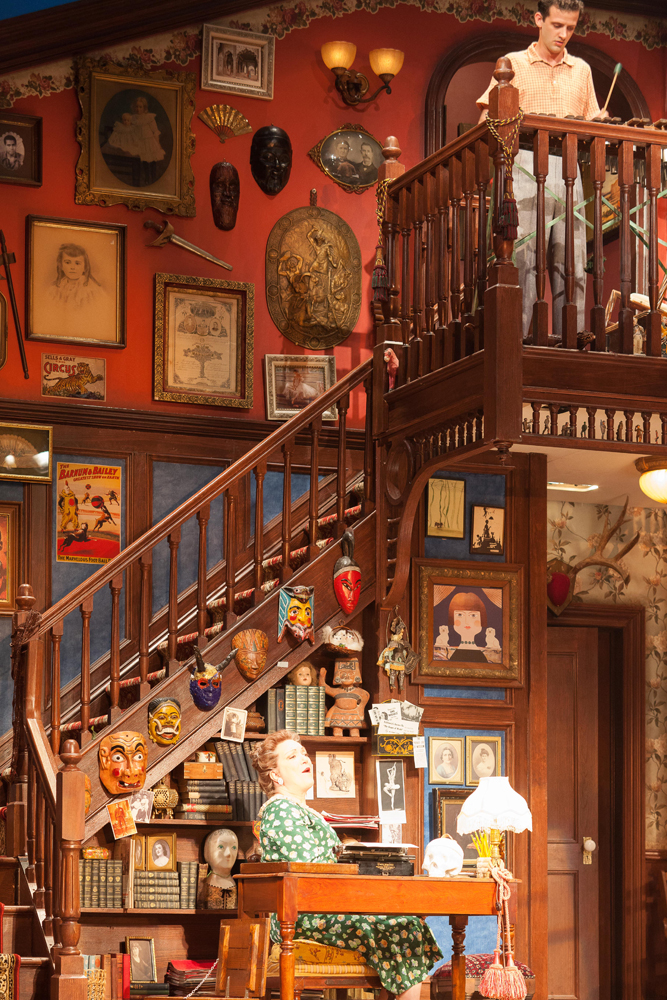
Like this smattering of objects throughout the room, politics pervasively pepper the dialogue of the play like Twitter hashtags, but in the form of inconsequential statements about democracy, taxes, communism, the Bolshevik revolution, capitalism, and Wall Street. Rather than attempt to make academic, articulate points about any of these things, their mention functions to contradict the play’s eponymous thesis—that “things” do not matter if you have not lived a life worth living. This thesis is, of course, slightly paradoxical for historians of material culture. On one hand, objects become cynically and manifestly unimportant in a life void of happiness. But on the other hand, if material culture can be the tangible expression of one’s existence, the “stuff” we leave behind becomes the description of who we were and of how and why we lived.
As Csikszentmihalyi and Rochberg-Halton noted, specifically about the home: “The material environment that surrounds us…either helps the forces of chaos that make life random and disorganized or it helps to give purpose and direction to one’s life.”[xvi] So these personal objects from the cast, specifically in conversation with the purchased and found elements of the set, make a profound point. Creating this familial continuum contributes to and celebrates the timelessness and universality of the play itself, in which disparate families from different classes come together like the “stuff” that fills the stage. To once again refer to our friends Csikszentmihalyi and RochbergHalton: “People still need to know that their actions matter, that their existence forms a pattern with that of others, that they are remembered and loved, and that their individual self is part of some greater design beyond the fleeting span of mortal years.”[xvii] In this set design, a pattern of human “mattering” is evidenced by objects collected, cherished, left behind, remembered and collected again, because, as you know, you can’t take it with you…
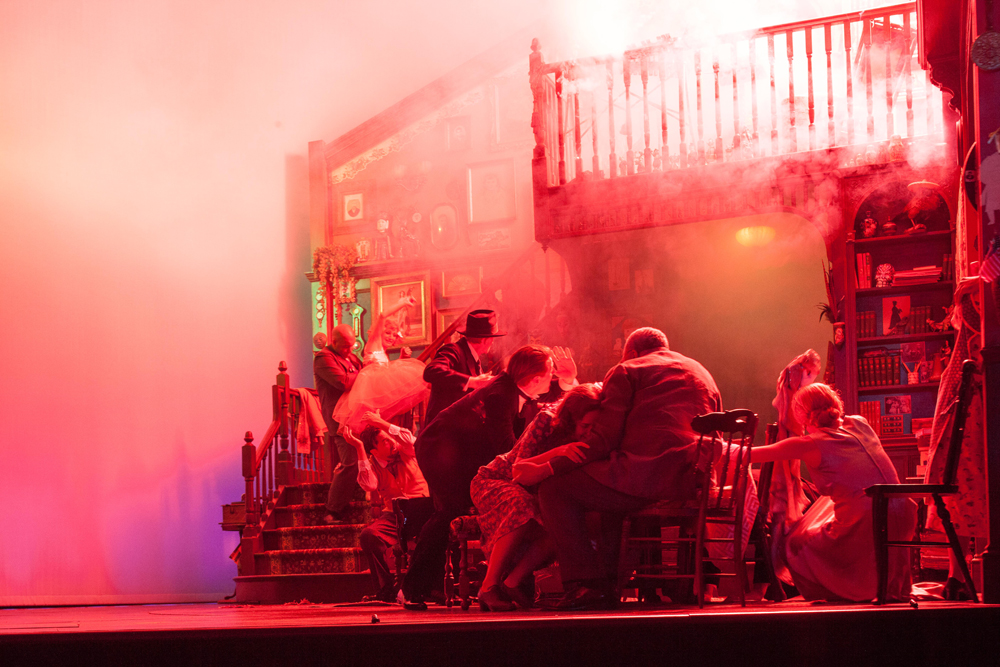
You Can’t Take It With You played at the Longacre Theater, New York, September 27, 2014–February 22, 2015.
Written by Moss Hart & George S. Kaufman
Directed by Scott Ellis
Scenic Design by David Rockwell
This article was originally published in Objective: The Journal of the History of Design and Curatorial Studies, Parsons School of Design, Spring/Summer 2015.
Notes
[i] Moss Hart and George S. Kaufman, You Can’t Take It With You (New York: Dramatists Play Service, 1964), 39.
[ii] David Rockwell, “You Can’t Take It With You: Upstage Guide” (brochure distributed by Roundabout Theater Company, New York, 2014), 14.
[iii] Ibid.
[iv] David Rockwell, e-mail message to author, January 29, 2015.
[v] Ibid.
[vi] Rockwell, “You Can’t Take It With You: Upstage Guide,” 14.
[vii] Hart and Kaufman, You Can’t Take It With You, 5.
[viii] Ibid.
[ix] Mihaly Csikszentmihalyi and Eugene Rochberg-Halton, The Meaning of Things: Domestic Symbols and the Self (New York: Cambridge University Press, 1981), 132.
[x] Ben Brantley, review of You Can’t Take It With You by Moss Hart and George S. Kaufman, directed by Scott Ellis, Longacre Theater, New York, New York Times, September 28, 2014, http://www.nytimes.com/2014/09/29/theater/you-canttake-it-with-you-handled-properly-ages-well.html (accessed March 2, 2015).
[xi] Rockwell, “You Can’t Take It With You: Upstage Guide,” 14.
[xii] “Ask a Star: Annaleigh Ashford,” Broadway.com, http://wwwbroadway.com/videos/ 155 706/you-cant-take-it-with-yo’us-annaleigh-ashford-cant-describe-herfriends-in-one-word/ (accessed January 23, 2015).
[xiii] Joe Dziemianowicz, “‘You Can’t Take It With You’ Set Design on Broadway Is a Family Affair,” New York Daily News, September 25,20 15, http://www.nydailynews.com/ entertainment/set-family-affiar-article-l.195291 0 (accessed January 22, 2015).
[xiv] Rockwell, e-mail message to author, January 29, 2015.
[xv] Ibid.
[xvi] Csikszentmihalyi and Rochberg-Halton, The Meaning of Things: Domestic Symbols and the Self, 17.
[xvii] Ibid., 145.
 Matthew J. Kennedy
Leave a comment