This article was originally published in Modern Magazine.
A PHANTASMAGORIC SCULPTURE FROM DANISH ARTIST AXEL SALTO
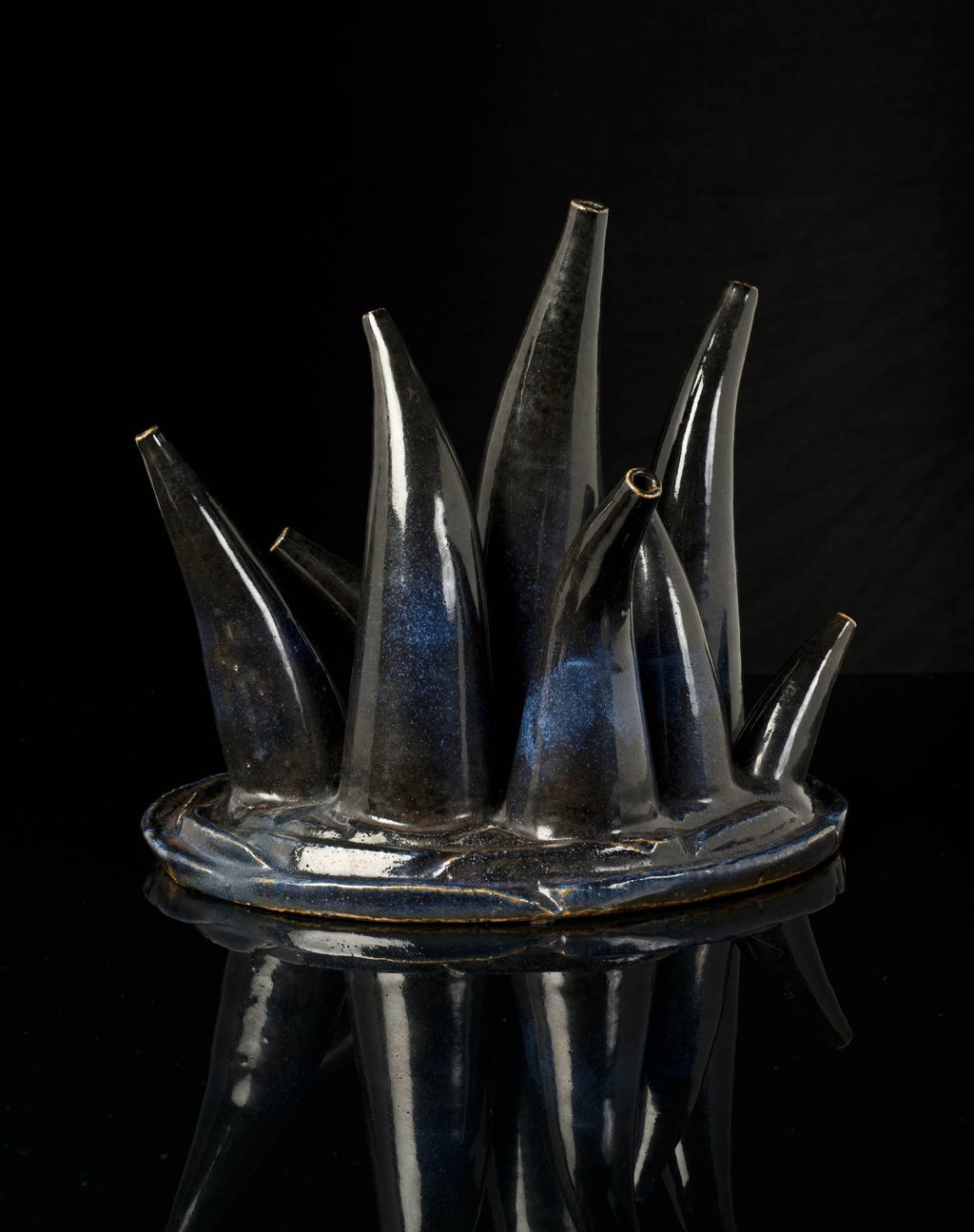
LOT 7 Piasa’s Axel Saito Ceramics sale, February 10,2015: Forest of Cones sculpture designed by Axel Salta, 1965. Estimated at € 40,000–€ 60,000 (approximately $45,000–$67,000), the piece sold for € 101,000 (approximately $113,000). Some reasons for the high price:

AT FIRST, ART
Axel Salto began as an artist, and some would argue that he ended as such. His diverse artistic training as a painter, sculptor, and ceramist at the Royal Danish Academy of Fine Arts set the stage for a varied, if sporadic, contribution to the visual arts throughout his career. His early endeavors included somber woodcuts and paintings of Greek myths as well as other classical themes, along with illustrated children’s books and textile designs. But, more importantly, in these early days, he deeply integrated himself into the Danish art discourse, inhabiting various social and professional circles that drove him to his modernist vision and practice. A much fabled meeting in Paris with Pablo Picasso and Henri Matisse in 1916 officially turned him in this modernist direction. What actual discussion took place is undocumented, but Salto credited this meeting with driving his aesthetic and artistic ambition. Starting in 1917 he edited and self-published the journal Klingen (Danish for “blade”), a title certainly suggesting a pugnacious perspective. Contributions to this publication would nurture and disseminate the forward-thinking ideals of Salto and his contemporaries, often with some controversy.
SHAPING CERAMICS
Salto’s shift into ceramics was cemented by his participation at the 1925 Exposition Internationale des Arts Decoratifs et Indust riels Modernes in Paris, where he presented a series of polychrome porcelains in association with Bing & Gr0ndahl, for which he won a silver medal. While always maintaining his personal studio on the side for both ceramics and painting, he produced prolifically for manufactories such as Bing & Grlondahl and Saxbo, before moving to the Royal Copenhagen Porcelain Manufactory in the mid-1930s, where he experimented with new glazes to expand the palette of Danish ceramics. His favorite of these glazes was solfatara, which produced a greenish-yellow color that characterizes much of his work. His artistic sensibilities as a painter put his ceramic work in sharp contrast with the functional modernists of his day, many of whom were chiefly inspired by Japanese ceramics. The organic ornamentation of his work was at subtle odds with austere functionalism, but added a new voice to the perception of modernist ceramics.
EXPERIMENTING WITH NATURE
It takes a more knowing scientific eye to discern which specific phantasmagoric phenomenon Salto is capturing in this sculpture, but it is clear that it evokes nature at its most sublime. His ceramics are popularly filed into the loose categories of fluted, budding, and sprouting, this piece being a crowning achievement of the last. As indicated by these categories, he realized forms through an elemental approach to natural processes, at times achieving almost representational likeness and at others challenging the forces of nature and raising the question, “where in the world does this happen?” He aspired to “create in accordance with nature, rather than to copy its exterior.” According to Piasa specialist Frederic Chambre, Saito’s “highly original designs marked a unique transition of the poetry of nature to the world of ceramics.” His early study of mythology subtly resonates in the abstract and almost sinister tone of his ceramics. In this piece, the viewer is met by the horned head of some demonic beast or the moonlit sprouting of a biologically undetermined plant species. It is often said that Saito’s work blurs any articulated division between art and design, but to be consumed by such an argument is a disservice to the sensual, visceral presence of the ceramics.
SPROUTING SALES
Interest in Salto’s work has surged in the last few years, with individual pieces bringing record-breaking prices. But Piasa’s recent monographic sale represents a maturation of Salto’s work in the eyes of the market. As noted by Chambre, “While an amazing curatorial challenge, the rarity and importance of the works brought great appeal, as Axel Salto was a multifaceted artist renowned for his ceramic output. We decided to explore more of Salta’s creation and found new buyers for his ceramics.” Indeed, Salto’s ceramics are now coveted by contemporary art collectors, ceramics specialists, and design lovers, all seeking to secure pieces for private and public collections, with many already housed in decorative arts and ceramics museums. Of this piece, specifically, Chambre comments, “it is the apotheosis of his creative output. Unique and dating from 1965, it was anticipated as very rare to the market.” The estimated price was averaged from previous results, taking into account technical complexity, date, and rarity. Whether budding, sprouting, or fluted, Salto’s ceramics are likely to bloom in any collection.
 Matthew J. Kennedy