This article was originally published in Modern Magazine.
A SMART MODERN CHAIR FOR THE FASHIONABLE WOMAN
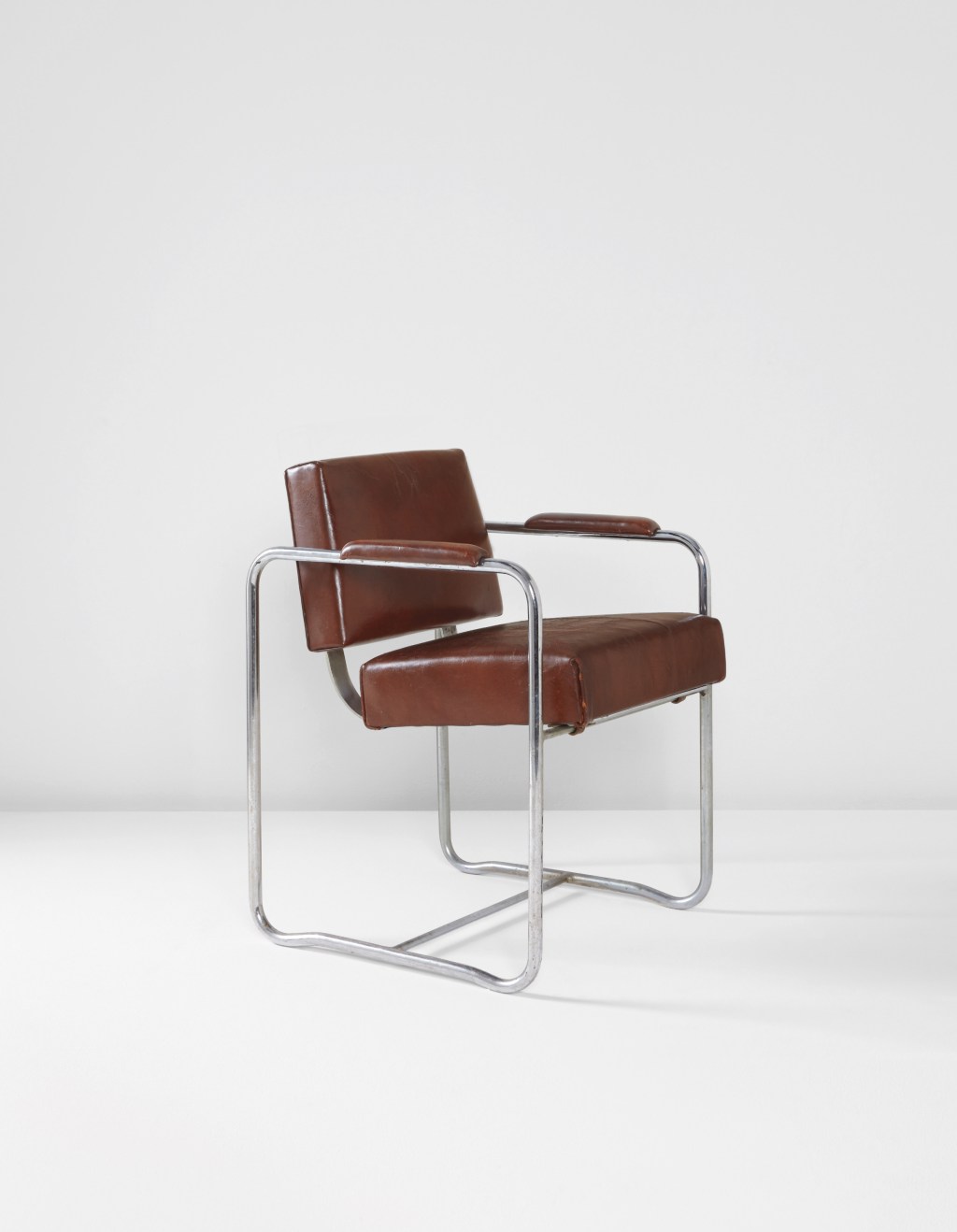
LOT 36 Phillips New York Design sale, June 9, 2016: Armchair from the millinery department of the Hattie Carnegie Salon designed by William Lescaze, circa 1931. Estimated at $8,000–$12,000, the piece sold for $21,250. Some reasons for the high price:
BUILDING BLOCKS
In 1920 William Lescaze came to America after studying architecture in his native Switzerland under Karl Moser. Lured by skyscrapers, machines, and the potential to build at a monumental scale, Lescaze made a pit stop in New York before taking a job in Cleveland at the architecture firm Hubbel and Benes. But stifled by its conservative practices and eager to exercise his own modernist vocabulary, he resigned as soon as he received his first outside commission, for a simple house renovation in New York. Lescaze’s crowning architectural achievement, with then-partner George Howe, was the Philadelphia Savings Fund Society Building (1932), an elegant slab hailed as the first (and some argue best) International style skyscraper in the United States. While known and practicing primarily as an architect, Lescaze also participated in exhibitions sponsored by such retail establishments as R. H. Macy’s that were intended to promote modern design to Americans. In these venues, he focused on industrial design, embracing a comfortable interpretation of form follows function.
FROM SKYSCRAPERS TO BESPOKE
During what was arguably his business boom in the early 1930s—which included his innovative design of the first International style town house in New York City in 1934—Lescaze designed a group of chairs for the millinery department of the Hattie Carnegie Salon in New York. Located at 42 East 49th Street, the famous boutique was known for its style and reliable importation of the newest and chicest Parisian taste. After years of producing strictly custom garments, Carnegie began to produce ready to- wear under the label “Spectator Sports” in the early 1930s to accommodate the shrinking pocketbooks of its post–market crash customers.
How Carnegie came to court the chairs from Lescaze is not known, but the avenues of fashionista and architect invariably intersected. Made from chromiumplated tubular steel and leather, the chair’s modernist materials would be expected within typical modernist confines, but Hattie’s boutique echoed the Parisian salons from which many of the fashions came, and included gold boiserie and Louis XV-style furniture. In the millinery department, the Lescaze chair was placed before a mirror flanked by wood paneling, so clients could observe their appearances while trying on hats. Perhaps it was this practicality rather than leisurely shopping that dictated the modern design, but either way, Lescaze arranged a smart modern chair for the fashionable modern woman.
RARE AND IMPORTANT PERFECTION
The chair was produced contemporaneously with Lescaze’s celebrated P.S.F.S. building and is similar in design to the ones he created for the building’s interior, though of slighter proportions, according to the Phillips team. The lone known sibling of the Carnegie chair (it is not known how many were made in total) resides in the Museum of Fine Arts, Houston.
The chair was produced contemporaneously with Lescaze’s celebrated P.S.F.S. building and is similar in design to the ones he created for the building’s interior, though of slighter proportions, according to the Phillips team. The lone known sibling of the Carnegie chair (it is not known how many were made in total) resides in the Museum of Fine Arts, Houston.
 Matthew J. Kennedy