This article was originally published in Modern Magazine.
A GLASS MOBILE WITH A BRIGHT POP PALETTE BY FRANCES AND MICHAEL HIGGINS TELLS A STORY OF LOVE AND LIFE IN THE TWENTIETH CENTURY.
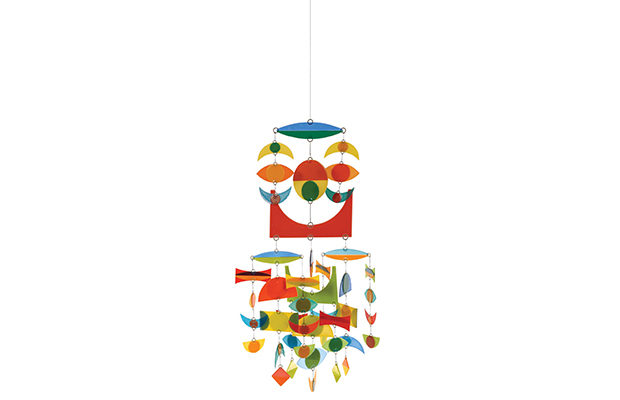
LOT 617 Treadway Toomey Auctions 20th Century Art & Design sale, March 5, 2016: Mobile by Frances and Michael Higgins, 1960s. Estimated at $1,200–$1,500, the piece sold for $1,900.
BOY MEETS GIRL AND GLASS
Frances Stewart was a professor of art at the University of Georgia when, after World War II, she pursued master’s studies at the Chicago Institute of Design. Stewart had been experimenting with such techniques as “bending” glass since 1942, and Michael Higgins, the head of visual design at the school, had taken a keen interest in the art of glass fusing. The two forged a professional and personal relationship over the medium and married in 1948, settling in Riverside, Illinois. Like most newlyweds, they established a home; unlike most newlyweds, their living room furniture featured three kilns frequently fired to up to 1,500 degrees Fahrenheit. Their collaboration in glass fusing in their unconventional setting fueled an inventive approach to everyday objects.
SAGGING AND SLUMPING
Frances and Michael Higgins—or “higgins,” as they collectively signed their work— revitalized the studio practice of glass fusing, a technique that had been supplanted by the popularity of glass blowing. Clear sheets of glass were coated in enamels of forty basic colors or decorated with colored pieces of glass, with the resulting designs matched or contrasted with other colors to produce hundreds of secondary colors when fused in glass “sandwiches.” The Higginses embraced a matter-of-fact vocabulary to describe their processes: glass heated at high temperatures could “slump” over a mold or be allowed to “sag.” The Higginses’ work began to glisten and gleam in retail in the 1950s, appearing in department stores such as Marshall Field’s and Bloomingdale’s. In 1957 the pair began collaborating with the Dearborn Glass Company to develop “Higginsware,” an array of domestic products in which color and decoration were infused into the very material of vases, ashtrays, and their famous rondelays (circular discs or square tiles fastened together to create decorative hangings, room dividers, and the like). Though Higginsware garnered the couple national acclaim, they returned to private studio work in 1966, favoring the artistic independence that had been sacrificed in adapting to mass production.
GEOMETRY SUSPENDED
Rondelays are perhaps the Higginses’ most iconic and enduring pieces, particularly at auction, having sustained a healthy market presence seemingly contradictory to their do-it-yourself ethos. (Still sold by the Higgins Studio today, the parts must be manually linked by the purchaser.) Lisanne Dickson of the Modern Design Department at Treadway Toomey attributes this success to the rondelays’ versatility. “They mark status with no comparable in terms of style,” she says, citing the Higginses’ use of color and form. While the rondelays may be notable for their service to spatial functionality, a playful spirit effervesces from the Higginses’ glass mobiles, also regular contestants at auction. With their pop palette of primary and secondary colors and congregation of humble shapes, an anthropomorphic personality emerges from the suspended pieces. The lot from the Treadway Toomey sale offers a particular vitality and intrigue.
CONNECTING COLLECTORS
This Higgins mobile came from an established Chicago-based collector of modern design. “Collectors like pieces from other collectors,” Dickson says. “There’s an emotional aspect rather than just ‘stuff’ from a vendor.” Mid-range prices, she also reports, attract a variety of buyers. Dickson priced the piece conservatively, both to manage and drive expectations about its value. Two absentee bids and two telephone bidders were outdone by a LiveAuctioneers buyer, and the piece went to a Los Angeles–based private collector, bringing in a high price for this type of Higgins glass. With a piece of such vibrancy and artistry, it is no mystery that a willing buyer would succumb.
 Matthew J. Kennedy